

High-Performance Thermal Interface Pad Materials: Technical FAQ
Time: 2026-05-29 17:10:50 Copyfrom: SuZhou Volsun Electronics Technology Co.,Ltd.
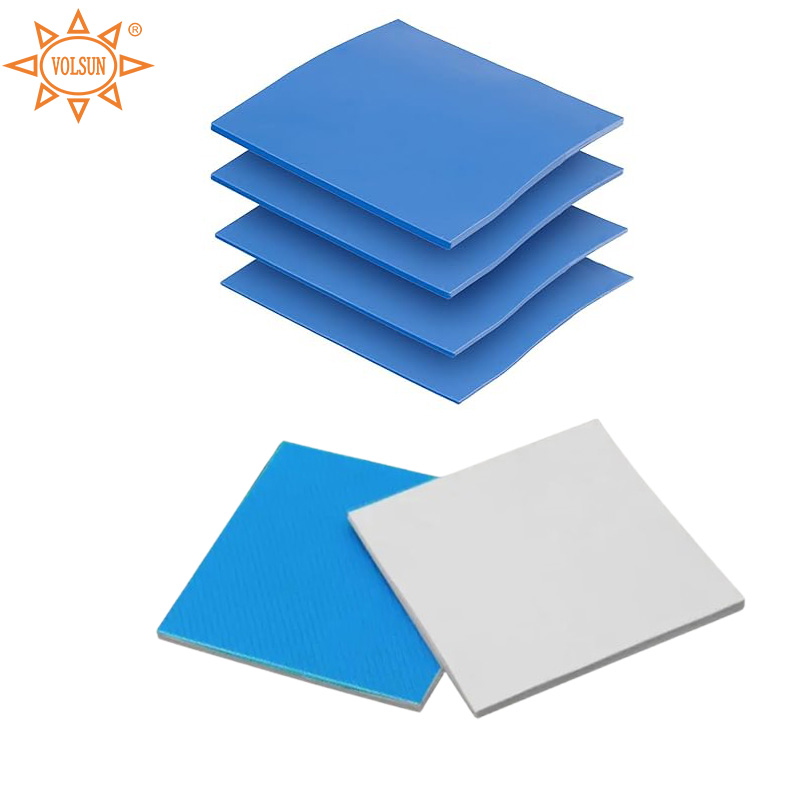
Q1: Will silicone thermal pads bleed silicone oil or experience outgassing during long-term operation?
Volsun utilizes advanced vacuum-stripping and heat-curing processes to reduce volatile content, preventing oil separation from contaminating sensitive optical or high-frequency circuits.
Q2: How do silicone thermal pads absorb mechanical manufacturing tolerances in electronic housings?
Silicone thermal pads feature low hardness and excellent compressibility, allowing a single pad to seamlessly deform and close uneven gaps across multiple components simultaneously.
Q3: Do Volsun silicone thermal pads feature inherent natural tack or surface stickiness?
Yes, our organic silicone thermal pads possess an inherent, natural surface tack on both sides. This structural stickiness acts as a temporary assembly aid to hold the pad in position on the heat sink or device chassis before the final mechanical clamping pressure is applied. Volsun can also produce thermal pads with additional adhesive coatings on request.
Q4: Can a silicone thermal pad be reused or repositioned after the electronic device is disassembled?
We generally do not recommend reusing a thermal pad that has been compressed for a long time, as the material undergoes structural relaxation to fit the initial microscopic peaks and valleys.
Q5: How does mechanical clamping pressure affect the performance of a thermal interface sheet?
Increasing the assembly clamping pressure compresses the soft silicone matrix, thinning the thermal path and forcing the material to wet the substrate surfaces more intimately. However, the pressure must be controlled to avoid exceeding the material’s elasticity limit or cracking delicate semiconductor solder joints on the PCB.
Q6: Are there any specific cleaning protocols required before applying a thermal pad onto a component?
To achieve peak thermal performance, the substrate contact surfaces must be completely dry and free from dust, manufacturing oils, fingerprints, or other industrial pollutants. Cleaning the target area before installation ensures the soft pad achieves flawless micro-surface contact.
Q7: What is the primary manufacturing process behind Volsun silicone thermal sheets?
Volsun silicone thermal pads are manufactured by first thoroughly mixing organic silicone base materials. The compound is then systematically rolled through a precision calendering line, vulcanized under controlled heat to set its thickness, and finally die-cut into specific dimensions.
Q8: Can silicone thermal pads cause chemical corrosion to copper or aluminum heat sinks?
No, our silicone interface formulations are chemically inert and free from corrosive agents, making them perfectly safe for direct contact with metals like copper, gold, and aluminum.
Q9: Why is the volume resistivity of a thermal pad important for power electronics?
Volume resistivity measures a material's resistance to electrical leakage through its bulk body, which is critical when a pad sits between live high-voltage components and grounded metal enclosures. Our pads maintain a volume resistivity equal to or greater than 1.0 x 10¹² Ω·cm, providing ironclad electrical isolation alongside superior heat transfer.
Q10: How do I determine the ideal compression rate for a Volsun silicone thermal pad during assembly?
The sweet spot for optimal thermal performance and mechanical longevity typically lies between a 15% and 30% compression rate of the pad's original thickness. Compressing the pad within this verified range guarantees that all air is forced out of the interface while maintaining the material's structural resilience.
KEYWORD:thermal interface pad
RELATED_ARTICLES:
High-Performance Thermal Interface Pad Materials: Technical FAQ


